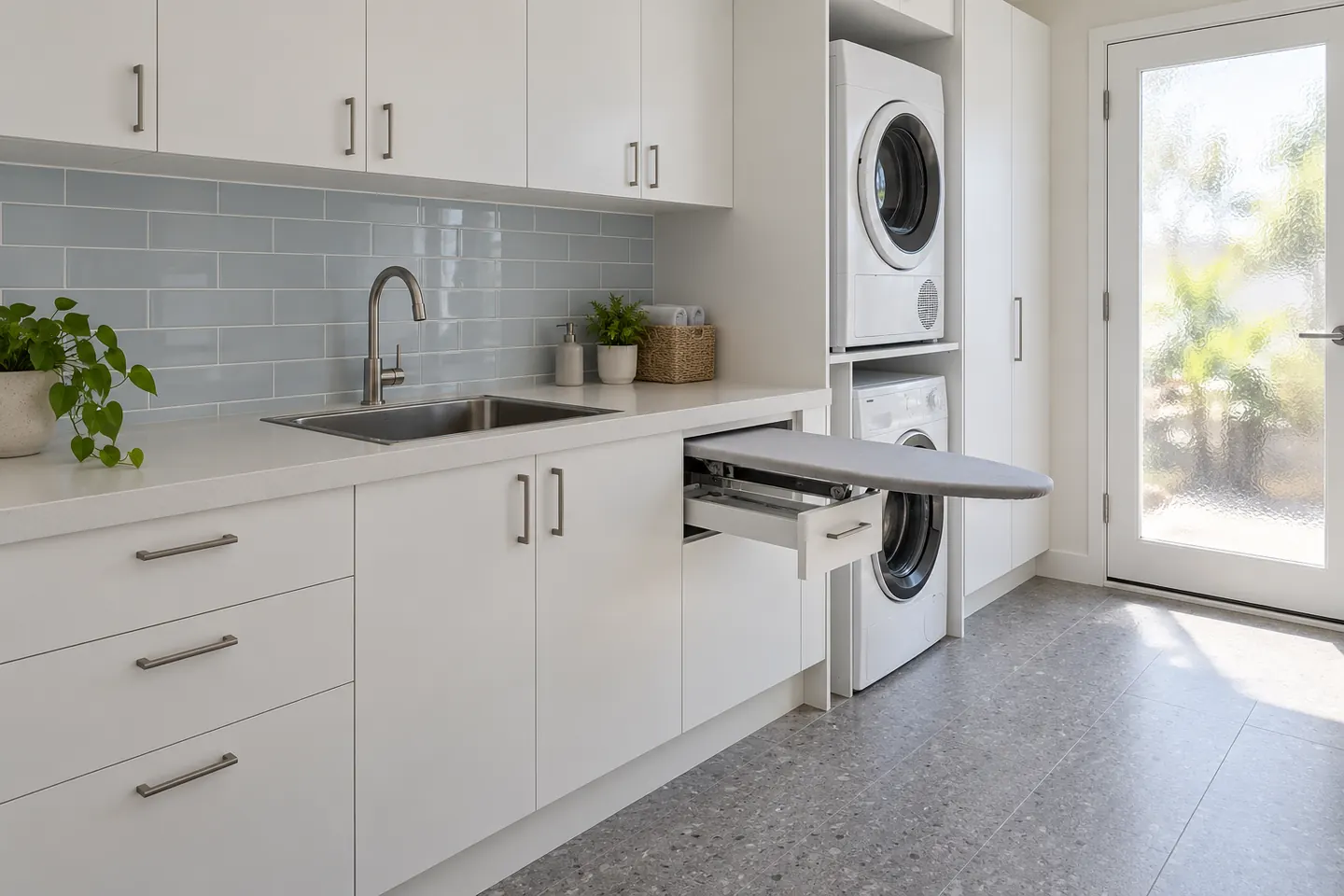
The laundry each kind of house has
In estate homes — Shell Cove, Flinders, Blackbutt, newer Albion Park — the laundry is usually an internal room off the garage or the kitchen. It has a stainless tub in a cheap cabinet, a single short run of bench if you are lucky, a tiled splashback, and the washer and dryer stacked or side by side with nowhere to put a basket.
In the older stock — Oak Flats, Mount Warrigal, Warilla, Barrack Heights, older Albion Park — the laundry is often in a rear add-on or under the house. Concrete tub, taps straight off the wall, a copper or galvanised supply, a floor waste that may or may not work, fibro lining, and a step down from the main floor level.
In units and townhouses the laundry is frequently a cupboard with a stacked pair and no ventilation at all.
Three different rooms, three different scopes.
What makes a laundry work
Bench you can actually fold on. The single most-missed thing. Even 900 millimetres of continuous bench beside the machines changes how the room is used.
A deep tub. Deep enough for a mop bucket, a nappy bucket or a dog, with a tap that clears the rim.
Storage from floor to ceiling. Tall and narrow beats wide and low. Somewhere for the vacuum, the ironing board, the mop and the detergent that is currently on the floor.
Somewhere for the baskets. Two or three baskets live in a family laundry permanently. Designing a slot for them is free; not designing one means they live in the doorway.
A drying plan. A rail, a wall-mounted fold-down line or a ceiling airer for the weeks when the Illawarra sky refuses to cooperate.
Ventilation. A laundry generates more moisture per hour than a bathroom. It needs an opening window, a fan, or both, and the dryer needs to discharge outside.
A floor waste that works. Particularly where a hose can fail. Correct fall to a functioning waste is the difference between a wet floor and a wet house.
The jobs that come up most
The garage conversion
Moving a cramped internal laundry into a corner of the garage, where there is room for a real bench, a sink and proper storage. Needs drainage and water run, a ventilation path, lighting and power, and a decision about whether the space is enclosed. Where enclosure is involved there can be approval and separation requirements, which Shellharbour City Council or a private certifier determines.
The rear add-on rebuild
Common in the older suburbs. The laundry sits in a lean-to or an enclosed verandah, with a damp floor, a step down and fibro linings. Scope here usually includes asbestos testing first, replacing supply pipework, fixing the floor and getting the levels and drainage sorted — more building than cabinetry.
Laundry with the bathroom
Where the laundry backs onto or shares a wall with the bathroom, doing both at once is efficient: shared waterproofing, shared tiling, shared trades, one skip. In older houses it is often the only sensible way, because the plumbing serving both is the same tired pipework.
Adding a toilet
A laundry already has water and waste in the room, which makes it the cheapest place in most houses to add a second toilet. It needs floor area, correct drainage, ventilation and usually approval.
Coastal and practical details
Laundries in houses near the ocean or around the lake entrance see the same corrosion as bathrooms, and often worse, because the room is damper for longer. Stainless fixings, decent plating on tapware, and a cabinet carcass rated for wet areas rather than raw particleboard.
Engineered stone is banned in Australia from 1 July 2024. Laundry benchtops here are porcelain, sintered surface, stainless, solid timber or a quality laminate — and in a laundry, laminate on a good substrate is a perfectly sensible choice.
What the quote covers
Cabinetry by type and finish, benchtop material, tub and tapware by model, the waterproofing scope for the room as laid out, the floor waste and fall, the dryer ventilation method, electrical work including any new circuits, and asbestos testing where the house is pre-1990. The NSW deposit cap of 10 per cent applies to residential building work.
Renovation work is carried out in partnership with Coastal Renovation Group, a licensed NSW builder. Licence and insurance details are provided on request.
See what it costs for guide tiers, or waterproofing and tiling for how the wet-area stages are handled.
Call 02 4214 4283 or send the room details through.
Other bathroom work
The rest of what gets quoted
| Full Bathroom Renovations | The whole room back to frame and slab, then rebuilt with a membrane, new pipework and fittings chosen to survive coastal air. |
|---|---|
| Ensuites | Project-home ensuites with a flexing acrylic base and a pivot door, reworked into a room two adults can use at once. |
| Small Bathrooms | Second bathrooms, powder rooms and narrow 1960s layouts where the set-out has to be drawn before anything is ordered. |
| Accessible Bathrooms | Level-entry showers, blocked walls for rails, non-slip floors and door widths that still work with a frame. |
| Waterproofing & Tiling | The two stages that decide whether the room lasts fifteen years or five, done to the standard and photographed before tiles. |
| Rental Bathrooms | Hard-wearing, quick-turnaround bathrooms for investment houses and units, scheduled around a vacancy rather than a mood board. |
Keep reading
Questions people ask before they commit
Does a laundry need waterproofing like a bathroom?
A laundry is a wet area, and the waterproofing requirements that apply depend on the layout — particularly the floor, the area around the tub and any shower in the room. It is not the same scope as a bathroom shower, but it is not nothing either, and a laundry on a timber floor needs it taken seriously.
Can the laundry be moved into the garage?
Often yes, and it is a common request in estate homes where the internal laundry is a cupboard. It needs drainage, water, a ventilation path and an electrical supply, and where a garage is being partly converted there can be approval and fire-separation considerations. Shellharbour City Council or a certifier decides what applies.
Do we have to vent the dryer outside?
A vented dryer should discharge to outside air. Running one into a small closed laundry, or into the roof space, pumps warm moist air into the building, and that moisture ends up as mould somewhere. The alternatives are a condenser or heat-pump dryer, which do not need a duct, or a proper external vent.
Can we put a second toilet or a shower in the laundry?
Sometimes, if the room has the floor area and the drainage can take it. A laundry with a toilet is a genuinely useful addition to a busy household and it is one of the cheaper ways to add a second convenience, because the services are already in the room. It needs the layout drawn and, usually, approval.
Is there asbestos in an older laundry?
Quite possibly. Laundries in pre-1990 houses — especially ones in a rear add-on or under the house — were often lined with fibre cement sheet, and old vinyl floor coverings and their backing can also be of concern. Anything from before about 1990 gets tested before it is disturbed.