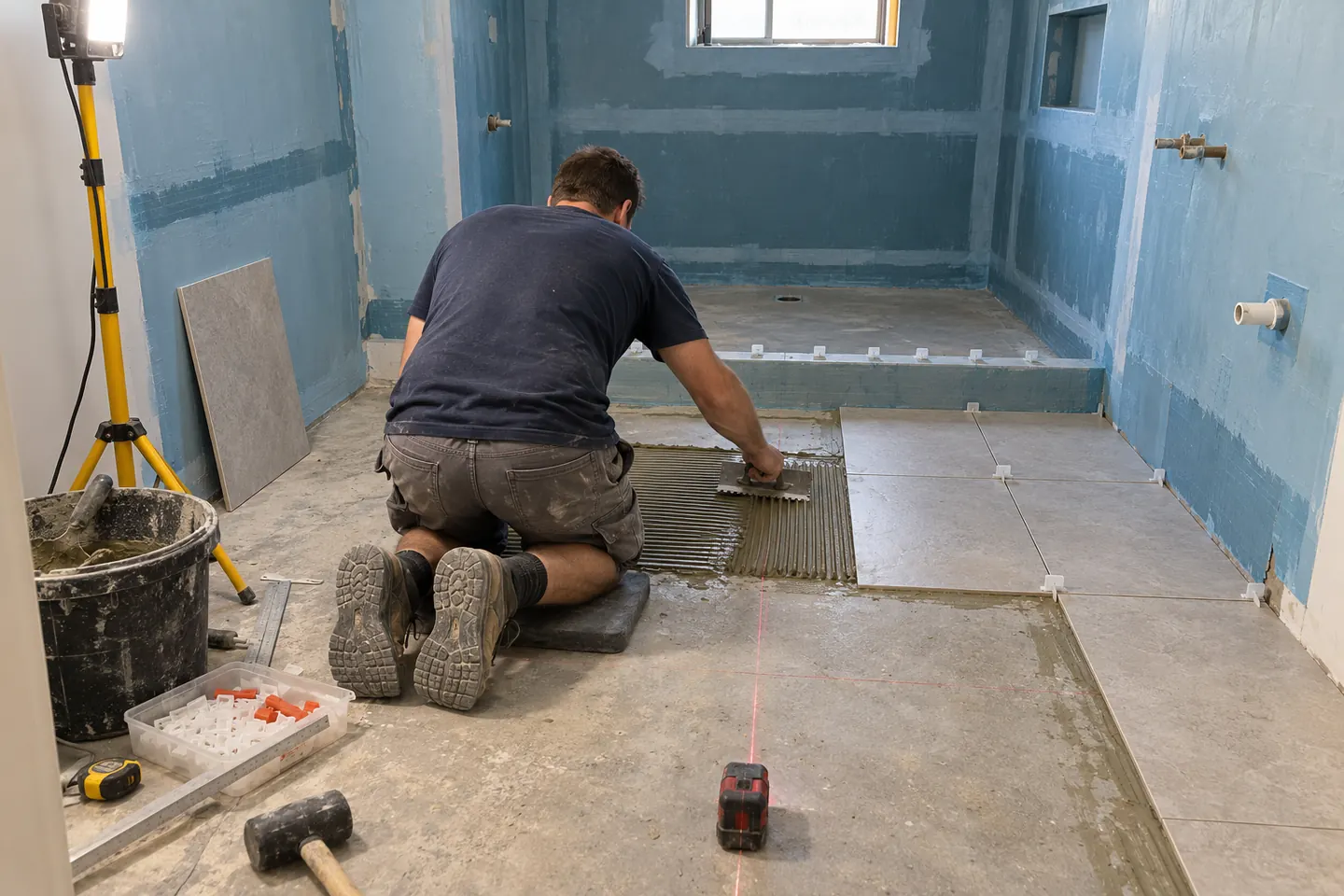
Why these two stages get their own page
Tiles are the thing people choose. The membrane is the thing that decides whether the choice was worth making.
In almost every failed bathroom we are called to look at, the finishes were fine. What went wrong happened before the tiles: a screed that did not fall to the waste, a membrane that was not detailed at a junction, a penetration that was never sealed, or tiles laid onto a membrane that had not finished curing.
That is also why these two stages can be bought on their own. If a bathroom has been stripped by someone else, or a renovation has stalled, the wet-area stages can be done as a standalone scope.
The screed, and why falls matter more than anything
Water does not leave a bathroom because of good intentions. It leaves because the floor is shaped to send it somewhere.
A screed is laid to fall toward the waste across the whole shower zone, and the rest of the floor is shaped so a spill or a wet exit does not pond in a corner. In a level-entry shower, where there is no hob to contain anything, the falls do all the work — which is why level entry is a screeding question, not a glass question.
Two local notes. On a timber floor in an older Oak Flats or Warilla house, the floor has to be flat, solid and non-bouncing before a screed goes anywhere near it. On a slab in an estate home, the existing floor level at the doorway often sets how much build-up is available, and that constrains the drain type.
The membrane
The membrane is a continuous waterproof layer bonded to the substrate, taken up the shower walls to the required height and detailed at every point where something interrupts it: the floor-to-wall junction, internal corners, the waste, tap and mixer penetrations, the shower rose outlet, the door threshold.
The detailing is the whole job. A membrane rolled across a floor by someone who has not bonded the corners is a decorative paint finish.
Things that matter in practice:
- The right primer for the substrate. Different board, different slab condition, different primer.
- Bond breakers and reinforcing at movement junctions, so the membrane can cope with the building moving.
- The stated number of coats, at the stated thickness, not "it looked thick enough".
- Cure time before anything is laid over it.
- Photographs of the completed membrane before tiling, kept with the job file. If nobody photographed it, nobody can show you it was done properly.
Cure time on a humid coast
This is the local part that catches people out. Shellharbour sits between the ocean and a wide shallow lake, and the air across the flat holds moisture. Water-based membranes cure by losing water to the air, and air that is already damp takes it slower.
So the practical rule here is to treat the manufacturer's cure time as the floor, add time in a wet or still week, and use airflow rather than optimism. The cost of waiting two extra days is nothing. The cost of tiling early is a bathroom that fails in the one place you cannot reach.
Tiling: the set-out is the craft
Anyone can stick a tile to a wall. The difference between a good tiling job and an average one is almost entirely the set-out, decided before the first tile is placed.
Where the cuts land. Full tiles on the sightline, cuts in corners, behind the door and under the vanity — not a 20 millimetre sliver down the middle of the main wall.
Vertical alignment. Floor joints and wall joints relating to each other, and the niche, mixer and rose landing on sensible joints rather than halfway across one.
Flatness. Large-format tiles are unforgiving. A wall that is 5 millimetres out over a metre shows as lipping between big tiles and does not show at all between smaller ones. The bigger the tile, the more preparation it needs.
Pattern cost. Herringbone, stacked verticals, mosaics and mitred external corners all look excellent and all take longer. They are a labour decision as much as an aesthetic one, and they belong in the quote as such.
Grout and silicone
Grout colour is the most under-thought decision in a bathroom. Brilliant white shows every mark; very dark shows every speck of soap residue. A mid-tone grey or taupe keeps looking clean with ordinary cleaning.
Epoxy or a high-performance grout earns its cost in the shower, particularly on the floor. And every movement junction — floor to wall, internal corners, around the vanity — is sealed with a flexible sealant rather than grout, because grout is rigid and the building is not.
What a standalone wet-area scope includes
Substrate check and preparation, screed and falls, primer, membrane with full junction detailing, documented cure time, photographs before tiling, set-out drawing, tiling, grouting and flexible sealing. Plus the waterproofing documentation at handover.
Waterproofing is licensed work in NSW. Renovation work is carried out in partnership with Coastal Renovation Group, a licensed NSW builder, and licence and insurance details are provided on request.
See full bathroom renovations for the whole sequence, or stage by stage for how long each part takes.
Call 02 4214 4283 or send the room details through.
Other bathroom work
The rest of what gets quoted
| Full Bathroom Renovations | The whole room back to frame and slab, then rebuilt with a membrane, new pipework and fittings chosen to survive coastal air. |
|---|---|
| Ensuites | Project-home ensuites with a flexing acrylic base and a pivot door, reworked into a room two adults can use at once. |
| Small Bathrooms | Second bathrooms, powder rooms and narrow 1960s layouts where the set-out has to be drawn before anything is ordered. |
| Accessible Bathrooms | Level-entry showers, blocked walls for rails, non-slip floors and door widths that still work with a frame. |
| Laundry Renovations | Garage and internal laundries given real bench space, a tub that fits a nappy bucket and a dryer that vents outside. |
| Rental Bathrooms | Hard-wearing, quick-turnaround bathrooms for investment houses and units, scheduled around a vacancy rather than a mood board. |
Keep reading
Questions people ask before they commit
How long does a membrane need before tiling starts?
It depends on the product, the number of coats and the conditions, and the manufacturer's instructions are the authority. What matters locally is that humid coastal air slows curing down, so the cure window on the data sheet is a minimum rather than a target. A job that tiles early to keep a start date is buying a problem.
Can waterproofing be done without stripping the bathroom?
Not properly. A membrane has to be continuous and has to be bonded to the substrate, which means it goes on bare board and screed, with junctions and penetrations detailed as it goes. Anything painted over existing tiles is a surface coating, not a wet-area membrane.
Should the whole floor be waterproofed or just the shower?
The required extent depends on the room, the floor type and the layout, and the Australian standard for waterproofing wet areas sets it out. In practice, a timber-floored bathroom in an older house warrants a more generous approach than a slab, because timber moves and the consequences of a leak are structural.
Is epoxy grout worth it?
In the shower, frequently yes. It resists staining and does not absorb water the way a cement-based grout does, which matters most on a shower floor and in the corners. It costs more to buy and more to install because it is less forgiving to work with. Elsewhere in the room a good modern cement-based grout is usually fine.
Who is allowed to do waterproofing in NSW?
Waterproofing of wet areas is licensed work in NSW and has to be done by someone appropriately licensed for it. You should receive documentation of the waterproofing at handover — ask for it, and keep it with the house papers.
Can you just re-grout and re-silicone instead?
If the membrane underneath is intact and the problem really is surface grout, a careful regrout and reseal is a legitimate, cheap repair. If the shower has been leaking for a while, the grout is a symptom and resealing it just hides the evidence for another year.