Before anything happens on site
The measure — about half an hour
Someone comes to the house and looks at the room properly: floor type, where the wastes run, what the wall behind the shower is doing, the condition of the supply pipework, the ventilation path, the access for materials and waste, and what you want the room to do.
This is also where the awkward questions get asked. How old is the house? Has the shower been leaking? Is there sheeting that needs testing? Is anyone in the household likely to need a rail in ten years? Free, anywhere in Shellharbour City.
The written quote — a few days
Itemised, with fittings named by model, a stated tile allowance, allowances for the things an older house hides, a variation method, and a program in working days. See what it costs for the guide tiers that sit behind it.
Selections and ordering — one to three weeks
The stage people underestimate and the stage that most often decides whether the program holds. Tiles, tapware, vanity, screen, toilet, fan, lighting and accessories all get chosen and ordered, and lead times get checked before a start date is set.
The rule is simple: everything that can be on site before day one, is on site before day one.
Approvals, where needed — variable
Most bathroom work inside an existing footprint with nothing structural changing is exempt development in NSW. If a wall is coming out, a window is changing or the footprint is moving, that is for Shellharbour City Council or an accredited certifier. If the property is strata, owners corporation approval for replacing waterproofing is the first phone call, not the last, because its timing usually sets the start date.
On site
Stage 1 — Asbestos testing, and removal if needed
Pre-1990 houses only, which in practice means much of Oak Flats, Warilla, Barrack Heights and the older Albion Park streets. Sheeting is sampled and tested before it is disturbed. If a result is positive, a licensed asbestos removalist does that part of the work and issues a clearance certificate before anything else restarts. Allow extra days, and expect the site to be sealed off while it happens.
Stage 2 — Protection and strip-out: two to four days
Floor and hallway protection, a sealed doorway, a skip in position. Then tiles, mortar bed, bath, shower base, vanity, toilet and wall linings all come out. Noisy and dusty, and the worst of the disruption is concentrated here.
Stage 3 — Looking at what is underneath: half a day
Once it is bare, the floor framing, the bottom plate and the frame get inspected. Anything found is photographed, shown to you and priced against the allowance already in the quote. In older local housing this is the most common reason a figure moves.
Stage 4 — Repairs: one to four days
Joists, bottom plates, a wall out of plumb, levels in a rear add-on that sits a step down from the house. Skipped entirely in a newer estate home; the main event in a tired one.
Stage 5 — Rough-in: two to four days
New supply and waste lines, and new wiring. Galvanised pipe replaced rather than patched. Anything moving position moves now. Also now: the exhaust duct run to an external vent, a dedicated circuit for a heated towel rail, lighting at the mirror, and blocking behind the linings wherever a rail might one day go.
Nothing on that list can be added later without reopening the wall.
Stage 6 — Sheeting and screed: two to three days
Wet-area board on the walls. A screed on the floor shaped to fall to the waste across the whole shower zone — the stage that decides whether a level-entry shower works.
Stage 7 — Waterproofing and the cure: one to two days of work, then the wait
Membrane to the floor, up the shower walls to the required height, detailed at every junction, corner and penetration. Photographed before anything covers it.
Then it cures, and this is the stage that cannot be hurried. Shellharbour sits between the ocean and a wide shallow lake, and damp still air slows a water-based membrane down. The manufacturer's cure time is a minimum here, not a target. The waterproofing and tiling page explains what goes wrong when it is squeezed.
Stage 8 — Tiling: four to eight days
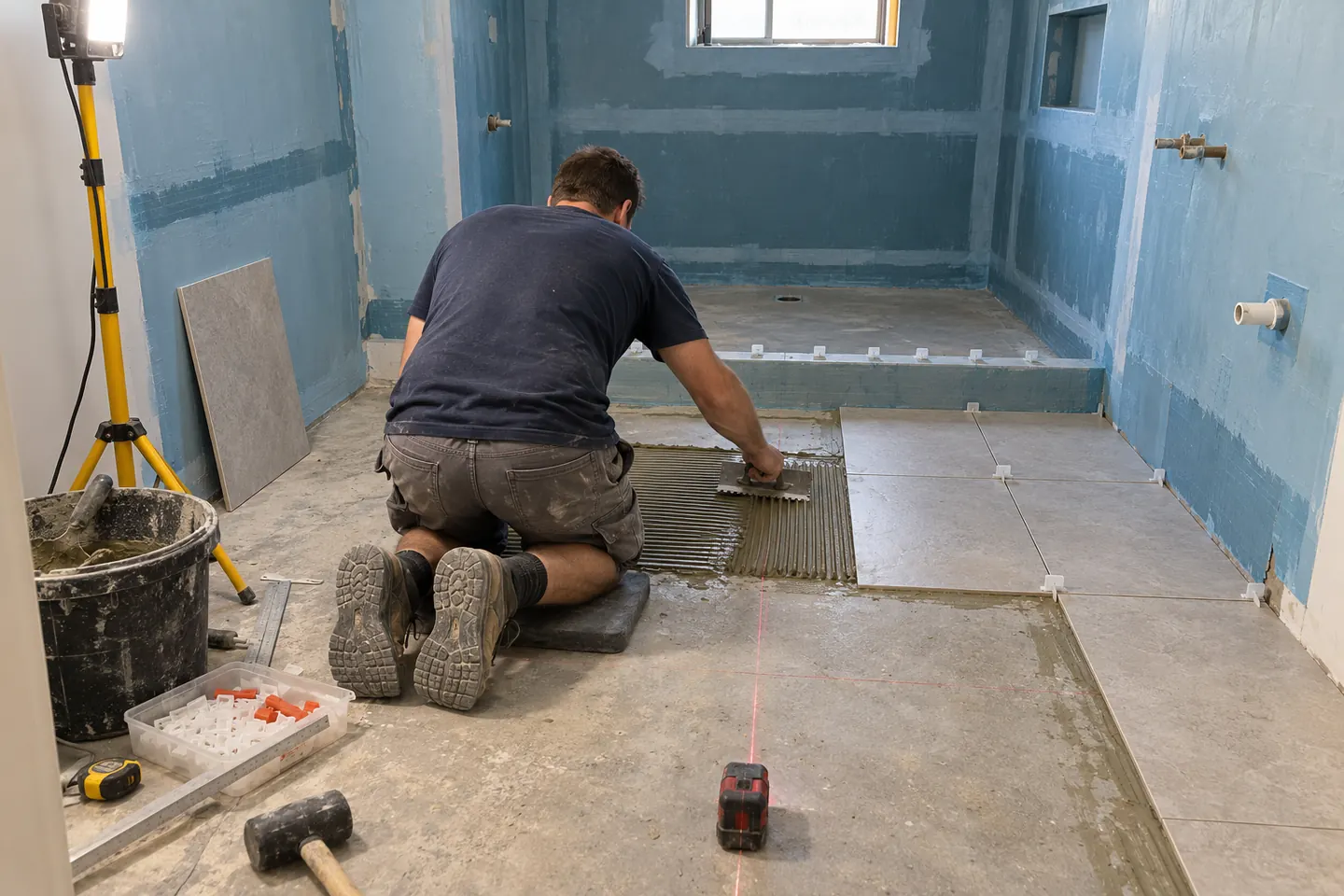
Set-out drawn first, so full tiles land on the sightlines and cuts land in corners and behind the door. Floor, then walls. Then grout, then flexible sealant at every movement junction. Large formats and patterned layouts sit at the longer end.
Stage 9 — Fit-off: two to three days
Vanity, toilet, tapware, screen, mirror, fan, lighting, rails and accessories. Plumber and electrician return to connect and test.
Stage 10 — Handover: half a day
Final clean, a walk-through with you, a defects list if there is one, and the waterproofing documentation handed over. Keep it with the house papers.
The three stages that cannot be compressed
The membrane cure. Physics, not scheduling.
Material lead times. A tile on a six-week lead stops a job regardless of how many trades are available.
Asbestos removal and clearance. Licensed work with its own process and its own paperwork.
Living through it
Expect noise and dust concentrated in the first week, then quieter trades. Expect trades to want early starts. Expect at least one day where nothing visible happens because something is curing.
If yours is a one-bathroom house, sort out where you are showering before day one rather than on day three. If the laundry has a toilet, or can have one added, that single change makes the whole program easier to live with — see laundry renovations.
Renovation work is carried out in partnership with Coastal Renovation Group, a licensed NSW builder. Licence and insurance details are provided on request.
Call 02 4214 4283 or send the room details through.
Planning pages and guides
Questions people ask before they commit
How long is the whole thing, start to finish?
On site, roughly three to five weeks for a single main bathroom. Before that, allow a couple of weeks from measure to signed quote, and then however long the longest-lead item takes to arrive. A realistic total from first phone call to handover is commonly eight to twelve weeks, most of which you are still using your bathroom.
Which stage takes the longest?
Tiling is usually the longest single trade on site. But the stage that most often stretches the program is waiting on a material that was ordered late, and the stage that cannot be compressed at all is the membrane cure.
Can we live in the house during the work?
Almost always, as long as there is another toilet and somewhere to shower. Households with a second bathroom barely notice after the first week of noise. One-bathroom houses need a plan — a relative nearby, a gym, or staging the work so a laundry toilet stays available.
What is the dustiest part?
Strip-out, and specifically removing a tiled mortar bed. It is a few days of genuine noise and dust. Protection, a sealed doorway and a clear path to the skip help a great deal, and it is over early.
What usually causes a delay?
Two things, in this order. Materials ordered after work starts rather than before, and selections that change mid-job. Asbestos removal, a floor that needs repair and strata approval are the next three, and all of them are predictable at the measure.
When do we pay?
A deposit of no more than 10 per cent in NSW, then progress payments tied to completed stages rather than to calendar dates. If someone wants a large payment upfront or payments on dates regardless of progress, that is a reason to walk away.